
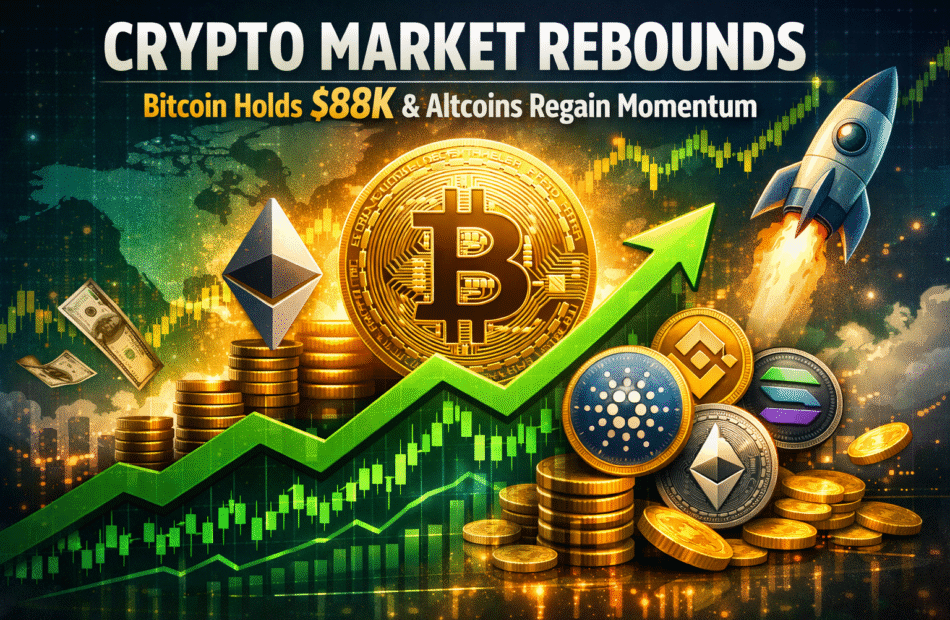
Crypto Market Rebounds as Bitcoin Holds Near $88K
Crypto Market Bounces Back as Bitcoin Stays Strong Near $88K
The crypto market is making a solid comeback. Bitcoin is holding steady around the $88,000 mark, which is helping boost confidence across digital assets. This price level has become an important support zone, keeping the market from dropping further. While the crypto space had slowed down a bit during the recent holiday period, things are picking up again.
Now, it’s not just Bitcoin seeing action. Major altcoins like Ethereum (ETH), Solana (SOL), and XRP are also gaining momentum. People are buying back in, and capital is flowing back into the crypto space.
Bitcoin Support Signals Strong Market Sentiment
Bitcoin holding above $88K is a good sign for traders and investors. AI-powered analysis shows that this price level is being defended well by buyers, even after some recent dips caused by ETF-related selling. As long as Bitcoin stays above this level, overall market sentiment is likely to stay positive.
This stable base gives other cryptocurrencies room to grow and helps restore investor confidence.
Ethereum, Solana, and XRP See Renewed Buying
Ethereum has climbed back over $3,000 as activity on its blockchain increases. More users are interacting with the network, which boosts its value. Solana has also seen strong gains as demand for faster, more scalable blockchains rises.
XRP is getting more attention too, with more liquidity entering the market. This reflects growing optimism around payment-focused cryptocurrencies.
AI Sees Capital Moving Back Into Crypto
AI tools that track blockchain data have picked up on key trends showing that investors are shifting money from safe assets like stablecoins back into riskier cryptos like Bitcoin and altcoins.
Here’s what AI is detecting:
– More trading volume in the spot market
– Altcoins becoming more liquid
– Less panic selling from everyday traders
This behavior suggests that people believe the market could be heading for a recovery in the near term.
Smart Money Is Buying the Dip
Data from AI-powered Bitcoin analysis shows that large investors—often called “smart money”—are still buying during price dips. This means they see current prices as a good opportunity to accumulate more crypto instead of selling.
These actions are in line with longer-term financial models that track where big money is moving over time.
What Could Happen Next in Crypto?
If Bitcoin stays above $88,000 and altcoins keep gaining strength, AI forecasts say we might see another upward move in the market. With better liquidity and more confidence from both retail and institutional investors, conditions are looking good for a continued rebound.
Bottom Line
The crypto market is showing clear signs of recovery. Bitcoin holding strong and rising interest in Ethereum, Solana, and XRP all point to improving momentum. AI-driven insights suggest that we could be in the early stages of a steady comeback—rather than facing more downside. Investors are returning, and the market may be ready for its next leg higher.

Crypto Trends 2025: What Flopped and What’s Next
**Crypto Narratives of 2025: What Failed and What Might Be Next**
In 2025, the crypto world was filled with big ideas and bold predictions. Some of these trends sparked excitement, while others fell flat. Let’s break down a few of the major crypto stories that didn’t live up to the hype this year and explore what might still be on the horizon.
**The Bitcoin Super Cycle That Didn’t Happen**
One of the biggest expectations of 2025 was the so-called “Bitcoin super cycle.” Many believed that Bitcoin would break free from its usual four-year pattern and enter a nonstop rally. With growing institutional interest and better regulations, experts thought Bitcoin could soar past $150,000 and keep climbing into 2026.
But things didn’t go as planned. The market took a turn in the last quarter of the year, and Bitcoin’s price dropped instead of rising. This shift proved that the super cycle narrative wasn’t ready for reality just yet.
**AI in Crypto: Big Buzz, Little Impact**
Artificial intelligence was another hot topic in 2025, especially because it had such a strong impact on traditional markets like the S&P 500. Many thought AI agents would revolutionize crypto trading and project development.
Despite the excitement, AI didn’t make a big splash in the crypto space this year. Back in 2024, analysts at Messari had already warned that AI in crypto might hit a peak early in 2025 due to a lack of real use cases. They were right—there wasn’t enough development or useful AI products to keep the momentum going.
Still, some believe this story isn’t over. Experts think AI and blockchain could become more connected in 2026, with deeper integration likely ahead.
**Meme Coins Lost Their Spark**
In 2024, meme coins were everywhere—and making huge gains. They even helped boost activity on blockchains like Solana. But in 2025, things changed fast.
This year saw a wave of rug pulls—scams where project creators suddenly disappear with investors’ money. As a result, people lost trust in meme coins, and many pulled their money out.
On top of that, the overall crypto market became more focused on real value and long-term utility instead of wild speculation. Big investors, or institutions, started putting their money into projects with solid fundamentals. That shift pushed meme coins to the sidelines.
**Looking Ahead: Will These Narratives Return in 2026?**
Even though some of these big ideas didn’t work out in 2025, they may not be dead yet. Industry leaders are still talking about the potential for Bitcoin and Ethereum to enter a true super cycle next year. Others believe AI will finally find its place in crypto with better tools and smarter applications.
As we move into 2026, the focus seems to be shifting toward real value, strong technology, and long-term growth—rather than hype alone.
**Key Takeaways:**
– The Bitcoin super cycle didn’t happen due to market downturns.
– AI in crypto fell short because of weak product development.
– Meme coins lost popularity after repeated scams and rising uncertainty.
– The market is shifting toward projects with real-world value.
– Some failed narratives may return stronger in 2026.
These trends remind us that not every prediction comes true—but in crypto, there’s always another chapter waiting to be written.

Top Crypto to Watch: DeepSnitch AI Leads for 2026
Bitcoin might be trading nearly 30% below its all-time high, but Strategy CEO Phong Le says the big picture looks better than ever. With over 671,000 BTC on the company’s balance sheet—worth about $58 billion—Le isn’t worried about short-term price dips. He believes long-term investors focus on years, not weeks. Backed by growing U.S. government support and more banks in the U.S. and UAE jumping into crypto, Bitcoin’s fundamentals are rock solid heading into 2026.
Meanwhile, Ethereum isn’t looking quite as strong. Analyst Ben Cowen warns that even if ETH manages to climb back to its $4,878 high, it could be a “bull trap”—a fake rally followed by a sharp drop, possibly down to $2,000. Currently priced around $2,898, Ethereum would need a 40% surge just to reach its previous top. And if the broader crypto market turns bearish, ETH could struggle even more.
But there’s more happening in crypto than just BTC and ETH. Ethereum founder Vitalik Buterin recently talked about how AI tools like Grok can help keep platforms honest by questioning assumptions. This same approach is now showing up in new crypto projects that use AI to give real-time insights and transparency.
One of the standout names is DeepSnitch AI. This project is already live with tools that track blockchain activity, wallet behavior, and market sentiment. It’s built for traders who want to stay ahead of volatility. Three out of five planned AI agents—SnitchFeed, SnitchScan, and SnitchGPT—are already operational and integrated into one dashboard through something called Unified Intelligence.
Unlike many early-stage crypto projects, DeepSnitch AI isn’t just promises—it’s already working. The platform also offers staking with uncapped, dynamic rewards. Plus, special bonus codes can double your tokens until January 1st. For example, if you invest $5,000 using the code DSNTVIP100, you’ll receive $10,000 worth of DSNT tokens, which grow daily through staking rewards.
The presale price is currently $0.03080, up from its starting point of $0.01510. With launch just around the corner and real products already in use, many are calling DeepSnitch AI one of the best cryptos to buy before December ends. If the price reaches just $3.08—a realistic target—it could deliver a 100x return.
Polkadot is another well-known name under pressure as 2026 approaches. Trading at around $1.71 with a market cap over $2.8 billion, DOT is showing signs of weakness after failing to break resistance in a downtrend. The technical pattern suggests more downside unless the price quickly recovers key levels.
Still, Polkadot has strong fundamentals. It supports cross-chain communication and ranks among the top Proof-of-Stake networks in the U.S., thanks to its parachain architecture. For long-term believers, this could be a good entry point—but don’t expect moonshot gains like DeepSnitch AI’s potential.
Another interesting pick is Monad (MON), a Layer 1 blockchain currently priced at $0.02349 with over $230 million in daily volume. Unlike many coins, Monad has shown consistent growth with higher lows and strong buyer activity without relying on heavy leverage. With a current market cap above $250 million and a fully diluted valuation of $2.3 billion, MON is attracting attention as a serious player.
Monad’s disciplined accumulation and strong volume suggest it has room to grow. With only about 10 billion MON tokens in circulation out of a 100 billion max supply, early buyers have a clear advantage if the project continues to build.
Still, if you’re chasing big gains—like 100x returns—DeepSnitch AI is the more exciting opportunity right now. It’s live, it’s growing fast, and it’s built around powerful AI tools that actually work today—not someday in the future.
In short:
– Bitcoin is strong long-term despite current prices.
– Ethereum might not hit new highs soon and could fall again.
– Polkadot has solid tech but faces near-term risks.
– Monad shows steady growth but isn’t likely to explode.
– DeepSnitch AI offers rare upside with real utility and active development.
To get in before DeepSnitch AI launches—and before its bonus codes expire on January 1st—visit the official site, connect your wallet, enter promo codes like DSNTVIP50 or DSNTVIP100 during checkout, and lock in your position.
If you’re looking for top cryptos to buy before December ends as we head into 2026, DeepSnitch AI stands out for its working AI features, live staking rewards, and serious potential for big returns.

Crypto Outlook 2026: Real Utility and Revenue Take Lead
2025 was a rollercoaster year for crypto markets — full of highs, lows, and major shifts. On the positive side, U.S. regulations became more crypto-friendly, Digital Asset Treasuries (DATs) gained popularity, and there was growing use of AI in blockchain, along with tokenization of real-world assets (RWA). These changes helped push major cryptocurrencies like Bitcoin (BTC), Ethereum (ETH), Ripple (XRP), and Binance Coin (BNB) to new all-time highs.
However, the excitement didn’t last. In the second half of the year, market momentum slowed due to global economic uncertainty. Rising inflation, shifting interest rates from the Federal Reserve, and new tariffs created doubt among investors. Then came a flash crash on October 10 that hit over-leveraged traders hard. As a result, BTC and ETH, which were up 34% and 43% at their peak, ended the year down -7% and -12%.
Interestingly, while top coins struggled, others like privacy coins (Zcash and Monero) and exchange coins (BNB, OKB, KCS, HYPE) performed better. These sectors saw steady gains as traders looked for alternatives during the volatility.
Looking ahead, 2026 is shaping up to be more bullish. With inflation cooling down, the U.S. Federal Reserve is expected to lower interest rates, making risk assets like crypto more attractive again. This could bring a wave of institutional money back into the market.
Spot ETFs for Bitcoin and Ethereum are likely to play a big role in 2026. These funds could absorb more than 100% of new BTC and ETH being issued, driving demand even higher. At the same time, U.S. policymakers are working to bring stablecoins into the traditional financial system. This move could spark competition between banks and crypto issuers for control of digital dollars.
Real-world asset tokenization is also reaching a turning point. On-chain RWA volumes are expected to grow from billions to trillions of dollars as more traditional assets move onto blockchain networks.
Meanwhile, emerging sectors like decentralized AI and physical infrastructure networks (DePIN) are gaining serious momentum. Bittensor (TAO), a blockchain project focused on decentralized AI development, is standing out. It rewards developers for building and sharing machine learning models. In late 2025, Bittensor had its first halving event, reducing daily TAO emissions to 3,600 tokens — similar to Bitcoin’s supply control mechanism.
TAO’s limited supply and early lead in decentralized AI make it one to watch in 2026. The network’s “subnet” design has attracted a growing number of developers, helping it become one of the most active ecosystems in the space.
In the DePIN space, Helium (HNT) is leading by creating a decentralized wireless network. Now running on Solana, Helium has teamed up with major telecom companies like AT&T and Telefónica to use its hotspots for mobile data offloading. In late 2025, data credit burns reached $1.5 million per month — a sign that users are actively using the network.
Helium’s supply also halved in 2025, tightening its tokenomics. By Q3 2025, there were over 115,000 active hotspots — an 18% increase from the previous quarter. With rising demand for decentralized connectivity and real partnerships with carriers that include revenue-sharing deals, Helium is well-positioned for strong growth in 2026.
One major trend to watch in 2026 is the rise of crypto projects that generate real revenue and share it with token holders. These protocols operate more like traditional businesses — doing token buybacks, paying out fees, or offering staking rewards funded by actual earnings.
Investors are starting to prefer these models because they offer more transparency and less reliance on inflationary token supply. Projects with clear treasury management and automatic buyback systems are expected to gain the most attention in the coming year.
As the crypto world matures in 2026, expect increased focus on real utility, sustainable economics, and value-driven investments across both established and emerging blockchain sectors.
Silver Overtakes NVIDIA in Market Value Amid Surge
**Silver Surpasses NVIDIA in Market Value – What’s Really Happening?**
In a surprising twist, silver briefly became the world’s second most valuable asset on December 29, 2025, overtaking tech giant NVIDIA in market capitalization. Silver hit a staggering valuation of $4.68 trillion, slightly ahead of NVIDIA’s $4.63 trillion. This unexpected move put silver right behind gold in terms of global asset value, while also surpassing the entire cryptocurrency market, which stands at $3.01 trillion.
This shift caught many off guard, especially in the crypto and tech communities. Bitcoin and other digital assets were already facing declines, and this surge in silver highlighted a sudden pivot toward traditional, tangible assets.
**Why Did Silver Prices Skyrocket?**
Silver prices soared to $84 per ounce, jumping 6% in just one day. That marks a 170% gain in 2025 alone. Together with gold, precious metals added a massive $16 trillion to their total market value this year.
So, what caused this sudden spike?
Several key factors came together to drive silver’s rise:
– **Lower Interest Rates:** The Federal Reserve has moved towards cutting interest rates. This makes non-yielding assets like silver more attractive compared to savings accounts or bonds.
– **Supply Shortages:** Silver is facing a long-term supply deficit expected to last for at least five years. With limited availability and rising demand, the price naturally goes up.
– **High Industrial Demand:** Silver is essential in clean energy technologies—especially in solar panels and electric vehicles. Demand for solar panels alone jumped 64% last year.
– **Geopolitical Tensions:** Elon Musk warned about China’s new export restrictions on critical minerals, starting January 1, 2026. His comments brought attention to silver’s importance in industrial applications and triggered a wave of buying activity.
**What Does This Mean for Tech and Crypto?**
NVIDIA saw its market value drop from its November high of $5.1 trillion as investors began to question whether the AI boom is losing steam. Meanwhile, cryptocurrencies also struggled—Bitcoin is down 6% this year and has dropped 28% since its peak in October. Ethereum fell about 11%, with other tokens like Solana and Cardano falling even further.
Some crypto enthusiasts believe that silver’s surge could signal renewed interest in digital assets soon. However, many analysts think investors are simply looking for safer, more tangible investments due to growing economic uncertainty.
**Why Investors Are Flocking to Hard Assets**
Silver is unique—it’s both an industrial metal and a traditional safe-haven asset. In times of uncertainty, investors often look for physical assets like gold and silver to protect their wealth.
The current global climate—marked by inflation concerns, geopolitical stress, and supply chain disruptions—has pushed many toward hard assets. Silver stands out because it plays a critical role in technology and clean energy while still being a time-tested store of value.
**A Quick Rise, A Quick Fall**
Interestingly, just as quickly as silver rose past NVIDIA and crypto, it pulled back again. This kind of volatility is common in commodity markets and shows how quickly investor sentiment can change.
The big question now is whether this was just a temporary spike or the start of a bigger trend. As economic uncertainty grows, silver—and other precious metals—could continue playing a bigger role in investment portfolios.
**Key Takeaways:**
– Silver briefly overtook NVIDIA in market value, reaching $4.68 trillion.
– Prices hit $84 per ounce, up 170% this year due to strong demand and low supply.
– Lower interest rates and China’s mineral export restrictions also helped drive the rally.
– Tech and crypto markets saw declines as investors shifted to hard assets.
– The move may signal a larger trend toward safe-haven investments during uncertain times.
Whether you’re investing in AI stocks, cryptocurrencies, or precious metals, it’s clear that market dynamics are shifting fast. Keep an eye on silver—it might just be the unexpected heavyweight in today’s financial world.