
Bitmine Expands From Crypto to AI With Cooling Tech
Bitmine Immersion Technologies is best known for mining Bitcoin and recently investing in Ethereum. But there’s more to this company than just cryptocurrency. Its innovative tech could also play a big role in the world of artificial intelligence (AI).
Cryptocurrency and AI are two of the most talked-about technologies today. Each is powerful on its own, but when combined, they can unlock new opportunities for growth and innovation. Some companies are already starting to explore how these two areas can work together—and Bitmine is one of them.
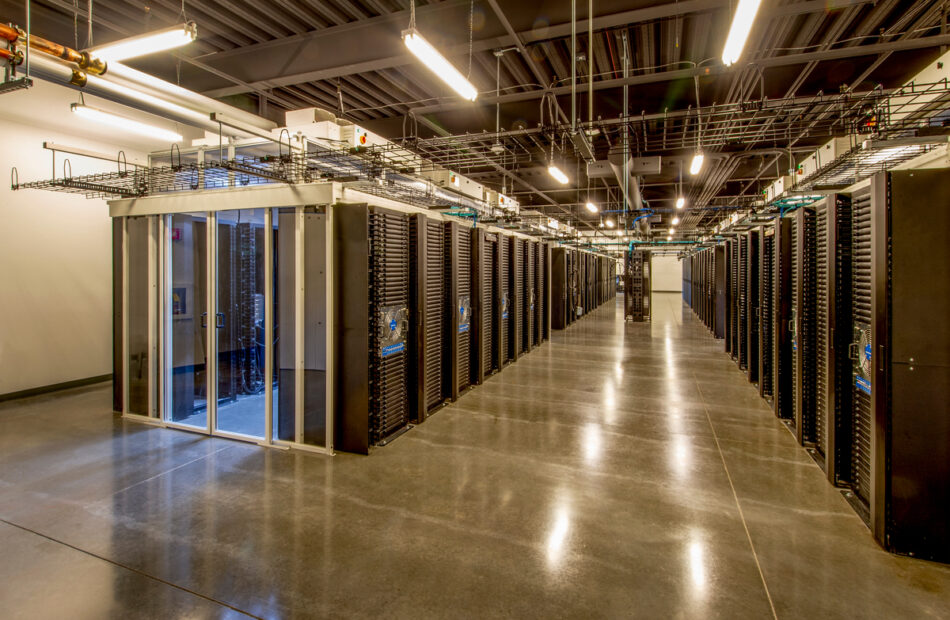
Bitmine specializes in Bitcoin mining, which uses powerful machines called ASICs (Application-Specific Integrated Circuits). These machines use a lot of energy and create a lot of heat, making cooling a major issue. To solve this, Bitmine uses a method called immersion cooling. This involves submerging the mining hardware in a special non-conductive fluid that absorbs heat more efficiently than air.
This same cooling method can also help with AI infrastructure. Like crypto mining, AI processing requires a lot of computing power, which also produces heat. Immersion cooling could help AI systems run faster and more efficiently while saving energy. In fact, research from Sandia National Laboratories shows that immersion cooling could cut energy use by up to 70%.
That’s a big deal—not just for the environment but also for AI companies looking to save on energy costs. For Bitmine, this means a potential new revenue stream that doesn’t depend on the ups and downs of the crypto market. As big tech companies continue to pour money into building massive data centers for AI, Bitmine’s cooling technology could become a key part of that infrastructure.
In short, Bitmine isn’t just about Bitcoin anymore. With its focus on immersion cooling, it could become an important player in the growing world of AI hardware and data center infrastructure.
DeepSnitch AI Presale Hits $450K as Meme Coins Slide
**DeepSnitch AI Surges Past $450K in Presale as Investors Shift Focus Away from Dogecoin**
The crypto market is in a state of correction, but one project is standing out — DeepSnitch AI. While meme coins like Dogecoin and Shiba Inu face price drops, DeepSnitch is gaining strong attention from investors, already collecting over $450,000 in its early presale phase. This growing interest signals a major shift in focus towards utility-driven AI crypto tools.
### DeepSnitch AI: Real-Time Crypto Intelligence for Smarter Trading
DeepSnitch AI isn’t just another token. It’s an advanced crypto analytics platform designed to help everyday investors make better trading decisions using artificial intelligence. The project features five powerful AI modules that constantly scan blockchain activity.
These AI tools monitor whale movements, liquidity changes, and new token launches. By detecting trends before they go mainstream, DeepSnitch gives users a serious edge in the market. Think of it as having a 24/7 crypto analyst that never misses a beat.
What makes it even more user-friendly is the dashboard. Instead of complex data, DeepSnitch offers easy-to-understand alerts and visuals. You’ll see where big investors are moving their money, which tokens are gaining or losing momentum, and which smart contracts might carry risks.
The platform has been audited by Coinsult and SolidProof, boosting its trust factor. On top of that, token holders can stake DSNT tokens to earn passive rewards while supporting the ecosystem’s growth.
At the current price of $0.01992, DSNT offers early adopters a high-upside opportunity. With stage two of the presale underway, analysts are already calling it one of the most promising AI-crypto projects of 2025. Some even believe DSNT could grow 300x as demand for crypto-AI tools surges.
### Dogecoin Struggles Amid Market Volatility
Dogecoin’s price prediction has turned slightly positive, but the popular meme coin is still facing challenges. After Bitcoin dropped to the $103k level, most meme coins followed the dip — including DOGE.
As of October 22, Dogecoin is trading at $0.1923, down 23.42% over the past month and 4.19% in the last week alone.
Still, there’s hope for recovery. A few companies have started building up their Dogecoin reserves, suggesting growing interest from institutions. If this trend continues, DOGE could bounce back to the $0.28 level in the next bull run.
### Shiba Inu Shows Signs of Recovery Potential
Shiba Inu (SHIB) has also suffered from recent market dips and volatility. After a tough few weeks — made worse by issues related to its Shibarium network — SHIB’s value now stands at $0.000009981, showing a 5.15% drop over the last week and a double-digit decline over the past month.
However, there’s still optimism. Many believe SHIB could regain strength before the year ends. If DeFi activity on its network picks up again, it could drive more demand and possibly lead to a price rally.
### Crypto ETP Growth Reflects Rising Demand for Regulated Exposure
In the background, regulated crypto investment products continue to grow in popularity. The U.S. now has 155 crypto exchange-traded products (ETPs), tracking 35 digital assets — a clear sign that institutional interest is rising.
Solana and Bitcoin top the list with 23 filings each, followed by XRP with 20 and Ethereum with 16. Other smaller assets like Dogecoin, Litecoin, Avalanche, and Polkadot also have several filings.
Experts believe that by 2026, total crypto ETP filings could exceed 200 as regulatory reviews speed up under SEC Chair Paul Atkins’ push for simplified approval processes.
Major players like Coinbase CEO Brian Armstrong and Galaxy Digital’s Mike Novogratz are also engaging with U.S. lawmakers to shape future crypto regulations.
### Why Investors Are Choosing DeepSnitch Over Meme Coins
While Dogecoin and Shiba Inu may rebound eventually, investors are clearly looking for more than just hype — they want real utility and innovation. DeepSnitch offers both.
Its AI-powered tracking and real-time insights provide real value to traders navigating today’s fast-moving market. With over $450K already raised in presale and growing buzz around its features, DeepSnitch is quickly becoming one of the most watched crypto projects this year.
For those looking to invest before the next tier price increase, DSNT tokens are still available at presale rates — but probably not for long.
**Keywords**: DeepSnitch AI, DSNT token, Dogecoin price prediction, Shiba Inu news, crypto presale, AI crypto project, blockchain analytics, meme coins, crypto ETPs, crypto regulation, SEC approvals, institutional crypto investment

Ozak AI ($OZ): The Next Big Crypto-AI Opportunity
In today’s fast-moving crypto world, smart investors are always on the lookout for the next big opportunity. Ozak AI ($OZ) is quickly gaining attention as a promising new project that blends Artificial Intelligence (AI) with DePIN (Decentralized Physical Infrastructure Network) — a powerful combination that could lead to massive growth.
Ozak AI isn’t just another token. It brings together AI tools, decentralized computing power, and blockchain infrastructure into one powerful ecosystem. If you’ve made profits from Bitcoin or Ethereum, Ozak AI could be your next big win — some experts even believe it has the potential to grow 400x by 2027.
🔥 $OZ Presale Is On Fire – Early Investors Already Gaining
The Ozak AI presale is live and gaining serious traction. Right now, you can get $OZ tokens at $0.012, but the price is set to rise to $0.014 in the next phase. The target listing price is $1.00. So far, investors have bought over 971 million tokens, raising more than $4.06 million. Since the start of the presale, $OZ has already increased by over 1100% — and there’s no sign of it slowing down.
Ozak AI rewards early supporters with real benefits: token staking for passive income, voting rights in project decisions, and the ability to be part of its growing ecosystem. This isn’t just a buy-and-hold token — it’s a way to be part of the future of decentralized AI.
🚀 Why Ozak AI Could Dominate the Next Decade
Unlike many crypto projects focused only on finance, Ozak AI is building a smart infrastructure that can learn, adapt, and scale. Its decentralized design spreads out computing power across multiple nodes instead of relying on big central servers. This setup makes AI models run faster and more efficiently.
The platform also supports cross-chain compatibility, meaning it works smoothly with other top blockchain networks. This gives $OZ token holders access to a wide range of apps and use cases across Web3.
Security is also a top priority. Ozak AI recently passed a full smart contract audit by Sherlock DeFi, which found zero issues. That means investors can feel confident that the system is solid and secure.
🤝 Key Partnerships Driving Ozak AI Forward
What sets Ozak AI apart is its network of strong partnerships that bring real-world value:
– **Hive Intel (HIVE):** Gives Ozak access to fast, multi-chain blockchain data to improve its predictive AI tools. This means better insights into crypto trends like wallet activity, NFTs, and DeFi.
– **Weblume:** Integrates Ozak’s AI signals into Web3 tools and no-code platforms so developers can easily build smarter apps without needing technical knowledge.
– **SINT:** Enables one-click upgrades for AI features like cross-chain bridges, voice commands, and autonomous bots — making everything run smoother and faster.
– **Meganet:** With over 6.5 million connected devices and 77K+ community members, this network helps Ozak process data faster and cheaper by sharing bandwidth across devices.
These partnerships make Ozak stronger and more useful, helping it grow faster while keeping costs low.
💡 Why Investors Are Switching from BTC & ETH to $OZ
Bitcoin changed money. Ethereum brought smart contracts. Now, Ozak AI is taking things further with intelligent infrastructure powered by decentralized AI.
Ethereum might still grow steadily in 2025, but it’s already a mature market. Ozak AI is just getting started — which means the potential for huge returns is still on the table. A $1,000 investment today could turn into $400,000 if $OZ hits its $1 target price after launch — a goal that looks realistic based on current demand and growth.
🌐 The Bigger Picture – Real Utility with AI + Blockchain
Ozak AI isn’t just focused on token value. It’s building a full digital economy powered by smart agents that make decisions automatically across crypto, Web3 apps, and even real-world systems.
As the world moves toward decentralized tech and AI-powered tools, Ozak AI stands out as a project ready to lead this shift. Thanks to its solid tech, strong partners, and growing user base, it’s more than just hype — it’s real innovation with long-term value.
Whether you’re new to crypto or a seasoned investor looking for your next flip, Ozak AI offers a rare mix of cutting-edge technology, solid performance, and community momentum — making it one of the most exciting opportunities in today’s crypto market.
Crypto Market Wavers as Fear Rises, Ethereum Eyes Upside
The crypto market is still struggling after a sharp drop earlier in October, dashing hopes for a recovery. On October 11, the market took a major hit when U.S. President Donald Trump announced higher tariffs on China, sparking fears across global markets. This news caused billions of dollars to vanish from crypto valuations and left investors rattled.
Since then, Bitcoin and other cryptocurrencies have seen small bounce-backs, but overall confidence remains low. The current mood is best shown by the Bitcoin Fear and Greed Index, which has fallen into the “extreme fear” zone. This level of fear has historically signaled that investors may start buying again, as panic pushes prices lower than what fundamentals support. However, history also shows that such fear can linger for weeks before a real comeback happens.
Investors are staying cautious due to growing global tensions and uncertainty around the U.S. Federal Reserve’s upcoming decision on interest rates. With key inflation data on the horizon, many traders are avoiding big trades. This has led to lower market liquidity and more dramatic price swings. Bitcoin is currently hovering around $109,000, while Ethereum is struggling to climb past important resistance levels.
Crypto research firm 10x Research recently pointed out that Bitcoin and Ethereum are moving in different directions in the options market. Their latest analysis shows that traders are mostly betting on Bitcoin to stay flat or go down, while Ethereum is showing signs of potential upside.
Looking at Bitcoin’s options market, traders seem to think the coin is more volatile than it really is. This creates opportunities for strategies like selling volatility through covered calls or short straddles. On the flip side, Ethereum’s options show that it’s less volatile than expected. That makes it attractive to those who think it could move more in the near future.
In simple terms, traders expect Bitcoin to stay steady or decline slightly, while Ethereum might be gearing up for a bigger move upward. Some investors are even selling Bitcoin call options to collect income from premiums. Meanwhile, Ethereum traders are buying put options to protect themselves from possible short-term dips.
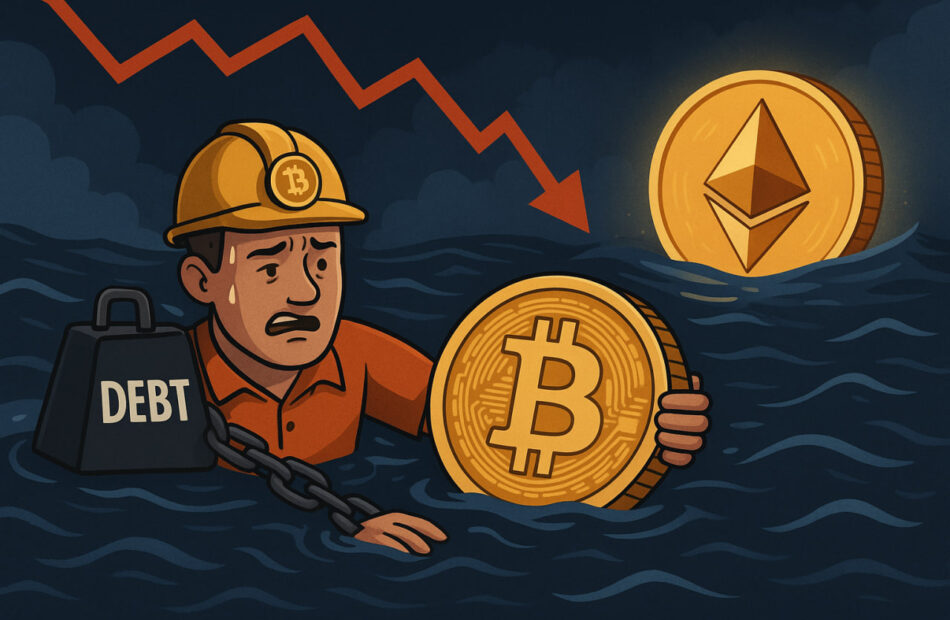
While short-term trading strategies focus on volatility, Bitcoin miners are facing a different kind of challenge—rising debt. A new report from VanEck shows that miner debt has jumped from $2.1 billion to $12.7 billion in just one year. The reason? Heavy spending on newer, more efficient machines to keep up with competition and maintain mining power.
This ongoing pressure has been called the “melting ice cube problem.” Miners must keep upgrading their tech or risk falling behind. In the past, they raised money by selling stock. But now, with weak market conditions, many have turned to borrowing instead.
At the same time, some mining companies are shifting gears by using their facilities for artificial intelligence (AI) and high-performance computing (HPC). This change helps them bring in steadier income and makes better use of their energy resources. For example, Bitfarms raised $588 million through convertible notes to fund AI operations in North America. Others like TeraWulf and IREN have also secured large loans to grow their data centers.
VanEck’s report says this pivot toward AI doesn’t hurt Bitcoin’s network security. In fact, it can help. By using mining equipment for both AI and crypto mining during off-peak times, miners can run more efficiently and reduce waste. This dual-purpose model helps them cut costs and survive during crypto downturns.
Even though fear dominates the current market mood, experienced investors know that such fear often comes right before a strong recovery. The difference in how Bitcoin and Ethereum are being treated in the options market could be an early sign that money is starting to shift within crypto.
As Bitcoin deals with global economic pressures and miner debt issues, Ethereum looks undervalued and could be setting up for a surprise move higher. Still, with so much uncertainty—from interest rates to world events—volatility will likely continue.
For now, fear rules the market. But in crypto history, fear has often opened the door to big opportunities.
Hong Kong OKs Solana ETF; DeepSnitch, XRP, LINK Rise
**Hong Kong Approves First Spot Solana ETF – A Big Win for Crypto Investors**
Hong Kong just gave the green light to its first spot Solana ETF, making it easier for people to invest in Solana through traditional finance. This makes it the third crypto ETF approved in the region, following Bitcoin and Ethereum. With this move, Hong Kong steps ahead of the U.S. by becoming one of the few places offering regulated Solana investment options.
The new Solana ETF was approved by Hong Kong’s Securities and Futures Commission (SFC) and will be managed by China Asset Management (Hong Kong). It will be listed on the Hong Kong Stock Exchange and will let investors buy into Solana using either U.S. dollars or Chinese yuan. One trading unit includes 100 shares, with a minimum investment of just $100, making it accessible for many people.
The fund is set to start trading as early as October 27. OSL Exchange will handle virtual asset trading, while OSL Digital Securities will be the sub-custodian. The total annual expense ratio, including all fees, is expected to be around 1.99%. Hong Kong now joins countries like Canada, Brazil, and Kazakhstan that already offer similar Solana ETFs.
This move shows growing trust in major altcoins like Solana and could help bring more money into the crypto market.
—
**DeepSnitch AI Raises $450K, Eyes Chainlink’s $12 Billion Market Cap**
A new crypto project, DeepSnitch AI, is making waves in the industry. It has already raised over $450,000 during its second presale stage and is gaining attention as a strong competitor to Chainlink, which currently holds a $12 billion valuation.
DeepSnitch AI brings something fresh to the table. While Chainlink connects blockchains to real-world data, DeepSnitch AI focuses on helping everyday crypto traders. Its main features include an AI-powered scam detector and tools that track large wallet (whale) movements—both of which are useful for spotting risks and opportunities in the market.
What makes DeepSnitch stand out is its appeal to regular users, not just developers or institutions. It’s designed to be helpful in both bull and bear markets, which gives it long-term staying power. Its utility isn’t based on hype—it solves real problems that traders face.
Currently priced at $0.01992 during presale, DeepSnitch AI could bring big returns if it reaches even a small portion of Chainlink’s market cap. Investors looking for high-growth opportunities are watching this project closely.
—
**XRP Price Outlook Strengthens with Institutional Support**
XRP is getting more attention from big players. A new Ripple-backed company called Evernorth Holdings Inc. has launched with the goal of promoting XRP use in traditional finance. The firm plans to raise $1 billion for an XRP treasury and is exploring a potential Nasdaq listing.
Ripple is also working to get direct access to the U.S. financial system by applying for a Federal Reserve master account. These moves show strong commitment to integrating XRP into mainstream finance.
However, XRP’s price hasn’t shown much movement lately. Despite bullish news, it has underperformed compared to other cryptos in recent days. Technical indicators are neutral right now, but long-term predictions suggest possible gains by early 2026.
—
**Chainlink Makes Big Moves with S&P Data Integration**
Chainlink just achieved a major breakthrough by bringing S&P Ratings data directly onto the blockchain. This allows smart contracts to access trusted financial ratings in real time—a major boost for DeFi projects needing reliable off-chain data.
This integration strengthens Chainlink’s value proposition as key infrastructure for the decentralized finance ecosystem. Large investors seem confident too—crypto analyst Ali Martinez reported that whales recently bought 13 million LINK tokens in just one week.
While price forecasts suggest moderate growth by late 2025, Chainlink’s strong foundation and ongoing whale accumulation make it a solid long-term bet.
—
**Final Thoughts: Crypto Momentum Builds Ahead of Bull Cycle**
With Hong Kong approving a spot Solana ETF and projects like DeepSnitch AI gaining traction, it’s clear that crypto is entering a new growth phase. Institutional interest is rising, and fresh innovations are attracting both retail and big-money investors.
DeepSnitch AI stands out as one of the top picks right now. If it reaches even a fraction of Chainlink’s $12 billion valuation, early supporters could see massive returns. The project is still in presale mode, offering low entry prices for those who want in early.
Now might be the best time to get involved—before the next bull run takes off.