

World App Update: Secure Chat, Payments & Web3 Tools
World App just got a major upgrade, making it easier and safer for people around the world to chat, send money, and use web3 tools—all while keeping their identity private.
The app, developed by Worldcoin creators Sam Altman and Alex Blania, now includes secure messaging, instant digital payments, and access to Mini Apps right inside chat threads. These new features aim to make the app more social and functional, while keeping user privacy and digital identity protection a top priority.
One of the biggest updates is the new World Chat. It lets users send messages, create group chats, and share photos or videos, just like WhatsApp or Telegram. But it also comes with built-in verification. Messages from verified users show up in blue bubbles, while unverified ones appear in gray. This helps users know who they’re really talking to. Profile pictures are also matched with stored images to prevent fake accounts.
You can now send and receive money directly in chats—instantly and with zero fees. Want to split a bill with friends or send money for someone’s birthday? It’s all possible within a single conversation. Transfers even come with fun animations for special occasions.
Mini Apps now run inside the chat too. These small apps let users play games, check prediction markets, or manage savings without leaving the conversation. It brings both fun and financial tools into one easy-to-use space.
The app has also expanded its digital asset features. Virtual accounts are now available in 18 countries, including the U.S., Japan, South Korea, Singapore, Taiwan, and several Latin American nations. Users can receive salaries, move money from their banks, and instantly convert it into stablecoins like USDC—all with no fees.
More currencies are supported now too, such as EURC, wMXN, wARS, wCLP, wBRL, wPEN, and wCOP. Verified users can earn rewards with high APY rates: up to 15% on USDC and 18% on WLD tokens. The Earn feature uses proof-of-humanity to make sure users aren’t creating fake accounts for extra rewards. Over 100 digital assets are available for trading, including Bitcoin, Ethereum, tokenized gold, and World Chain tokens.
World ID is getting smarter too. New tools include verified human badges (to reduce impersonation), age verification that protects your privacy, and even Tinder integration in Japan. With these updates, users can prove they’re real without giving away personal info.
However, not everyone is on board with how digital identity is being handled. Ethereum co-founder Vitalik Buterin warned that centralized identity systems could hurt user privacy and take away the freedom of staying anonymous online. He believes people might need multiple identities for safety or creative freedom.
Despite that concern, World App continues to grow fast. A new user joins every 1.7 seconds, and Orb ID verifications happen every 3.6 seconds. It’s now the most-used self-custody wallet globally.
As of now, Worldcoin’s token (WLD) is priced at around $0.598 with a daily trading volume of over $87 million.
In short, the World App update makes it easier to connect with people securely, move money across borders instantly, and manage digital assets—all while keeping your identity safe and private in the web3 world.

World App Adds Encrypted Chat, Crypto & Banking Tools
World App just got a major upgrade, adding powerful new features like encrypted chats, virtual bank accounts, and built-in cryptocurrency payments. These updates make it one of the most secure and user-friendly platforms for verified users around the world.
**Encrypted Messaging for Verified Users**
A new secure chat feature now helps users know who they’re really talking to. If someone is verified, their messages show up in blue bubbles. If they’re not verified, their messages appear in grey. This simple change makes it easier to trust who you’re chatting with and keeps spam and bots out.
Verification is done through a device called the Orb, which takes a 30-second scan of your iris and face. From this, it creates a unique digital code called an IrisCode, which confirms your identity without storing private data. It’s a smart way to prove you’re a real person online while still keeping your privacy.
**Virtual Banking and Crypto Made Easy**
With the new update, you can now receive money directly into a virtual bank account. You can also move funds from your regular bank account and convert them into cryptocurrencies like USDC, EURC, wrapped Bitcoin, Ethereum, or even tokenized gold. Over 100 digital assets are supported.
You can send and receive crypto right inside your chat, just like using Venmo. These in-chat payments will first be available in the U.S., starting in May, after biometric verification is complete. This system makes it simple and fast to use crypto for everyday payments, without needing to deal with complicated banking systems.
**One App for Everything: Identity, Money, and Chat**
World App is becoming more than just a messaging platform—it’s aiming to be a full “super app.” That means everything from chatting with friends, verifying your identity, sending money, and doing business across borders—all in one place.
The app’s developers say it’s built to handle the rise of AI and digital threats by offering strong security and real identity checks. It’s also designed to support global crypto use under tech-friendly policies, helping more people join the digital economy safely.
With these updates, World App combines secure communication, verified identity, and simple financial tools into one powerful platform. Whether you’re chatting with friends or sending money internationally, it’s now easier—and safer—than ever before.
U.S. Crypto Policy Shifts: SEC Eases, CFTC Steps Up
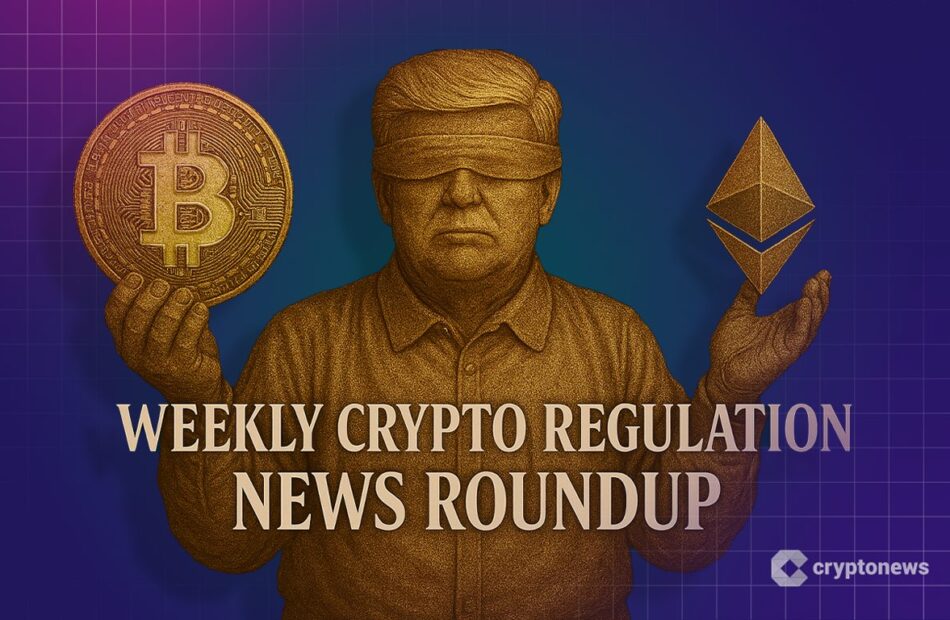
This past week brought major changes in U.S. crypto policy, signaling a big shift in how digital assets will be regulated going forward. From the SEC easing up on enforcement to the CFTC launching new programs, it’s clear that the government is rethinking its approach to cryptocurrency. Banks are starting to get more involved, and lawmakers are once again debating the future of a U.S. digital dollar (CBDC). Here’s a breakdown of the biggest developments.
Trump’s New Security Plan Skips Bitcoin – But That’s Not the Whole Story
The Trump administration just released its 2025 National Security Strategy, outlining top priorities in tech and global affairs. Interestingly, cryptocurrency didn’t get a single mention in the 33-page document. Instead, it focused on areas like artificial intelligence, quantum computing, and biotechnology.
This is surprising because Trump has already taken several pro-crypto actions, such as setting up the President’s Working Group on Digital Assets and signing the GENIUS Act to regulate stablecoins. Even though crypto wasn’t named in the security report, the administration’s recent moves suggest it’s becoming an important part of economic planning – just not yet a top concern for national security.
SEC Ends Investigation Into Ondo Finance With No Charges
In a major sign of changing attitudes at the SEC, the agency has officially closed its long-running investigation into Ondo Finance without taking any action. The case was focused on whether Ondo’s tokenized treasury products and its ONDO token were illegal securities.
This no-action outcome is part of a trend where several crypto-related cases have been dropped or delayed. It may signal the end of the SEC’s more aggressive stance on crypto regulation. It’s also a win for the real-world asset (RWA) sector, which connects traditional finance with blockchain technology.
CFTC Steps Up With New Crypto Pilot and Rule Changes
While the SEC appears to be stepping back, the Commodity Futures Trading Commission (CFTC) is moving full speed ahead.
Acting Chair Caroline Pham introduced a new pilot program allowing Bitcoin, Ethereum, and USDC to be used as collateral in derivatives trading. This will help regulators understand how digital assets perform under pressure and support safer integration into traditional finance.
The CFTC also made other big moves:
– They scrapped outdated 2020 guidance on Bitcoin delivery rules, which many said didn’t work with today’s crypto markets.
– They granted relief to four prediction market platforms – Polymarket US, LedgerX, PredictIt, and Gemini Titan – making it easier for them to operate legally.
These changes show that the CFTC wants to become the main crypto regulator in the U.S., especially as Congress seems ready to expand its authority.
Congress Reopens Debate Over U.S. Digital Dollar (CBDC)
Congress is once again fighting over whether the U.S. should launch a central bank digital currency. Rep. Keith Self from Texas introduced an amendment to block any development of a CBDC as part of the annual defense bill. He argued that previous promises to stop CBDCs were removed from the latest version of the bill.
This debate highlights strong political disagreements. Some Republicans believe a CBDC could harm financial privacy and give too much power to the government. Supporters say it could modernize payments and help America keep up with other countries developing digital currencies.
Banks Get Green Light for Crypto Trading
In a big move for traditional finance, the Office of the Comptroller of the Currency (OCC) now allows national banks to conduct “riskless principal” crypto trades. This means banks can buy crypto from one customer and sell it to another without holding it themselves, acting more like middlemen than traders.
This decision follows earlier OCC guidance allowing banks to hold crypto and offer custody services. Together, these steps bring traditional banks much closer to full participation in digital asset markets.
At the same time, regulators revealed that nine large banks had unfairly restricted services for crypto companies, highlighting a need for clearer and more consistent rules as banks enter the space.
Trump’s Pick for CFTC Chair Heads to Senate Vote
Michael Selig, Trump’s nominee to lead the CFTC, is now up for a Senate confirmation vote. If approved, he’ll take charge of an agency rapidly gaining power over crypto regulation. Selig has pledged to make the U.S. “the Crypto Capital of the World,” hinting at bold changes ahead.
This comes at a critical time: the CFTC currently has only one commissioner and is dealing with staffing shortages as its responsibilities expand.
The Big Picture: A New Era for Crypto Regulation
In just one week, U.S. crypto policy took major steps toward change:
– The SEC is backing off aggressive enforcement.
– The CFTC is becoming more active and assertive.
– Banks are being allowed to trade crypto.
– Congress is reigniting debates over CBDCs.
– Trump is reshaping policy through agency appointments.
All these shifts point to a new era where digital assets are no longer on the sidelines – they’re becoming central to economic strategy and regulation in America.

DeepSnitch AI Presale Booms, AVICI & CARDS Surge Ahead
CARDS Hits $2.6M Monthly Revenue, AVICI User Base Grows 35%, DeepSnitch AI Presale Tops $770K
The crypto market is currently going through a rough patch with a lot of ups and downs. But smart investors are still on the hunt for the next big winner—those rare projects that can potentially give 10x, 100x, or even 1000x returns.
Among the standout projects right now are CARDS, AVICI, and DeepSnitch AI. While CARDS and AVICI are doing well, DeepSnitch AI is getting the most attention thanks to its strong performance and unique AI technology.
DeepSnitch AI: The Rising Star in AI Crypto
DeepSnitch AI is an artificial intelligence-powered platform designed to help crypto traders stay ahead. It uses AI agents to analyze market data, on-chain activity, new token launches, and news—all in real time. This gives users a smarter way to make investment decisions faster.
The project is currently in its presale phase and already raised over $770,000. The token price has jumped 80% since launch. Right now, early buyers can benefit from a special bonus offer:
– Invest over $2,000 and get 50% more tokens with the code DSNTVIP50
– Invest over $5,000 and get 100% more tokens with the code DSNTVIP100
At the current presale price of just $0.02735 per token, a $5,000 investment (with the 100% bonus) gives you 365,630 tokens. If DSNT reaches $1 someday, that would be worth $365,630—about a 73x return.
With AI expected to grow 25x by 2030, according to Gartner, and Bank of America predicting it will be the most invested sector by 2026, DeepSnitch AI could be in the perfect spot to explode in value.
Ethereum Whales Are Accumulating Again
On-chain data from Santiment shows that big Ethereum holders (10K–100K ETH) have bought over 900,000 ETH in the past three weeks—worth about $3.15 billion. Meanwhile, smaller investors have been selling.
This suggests that big players have strong confidence in Ethereum’s future. After a recent price correction, ETH has rebounded 8% this December and is trading around $3,095. If this trend continues, it could soon return to above $4,000.
AVICI: The Web3 Version of Revolut
AVICI is a decentralized finance app that acts like a crypto-native bank. It offers a Visa-backed crypto card that lets users spend their tokens instantly as fiat currency—all while maintaining full self-custody. The card works seamlessly with Apple Pay and Google Pay in more than 40 countries.
With its current market cap at just $47 million and a user base growing by 35% every month, AVICI is being compared to Revolut—a major fintech firm worth $75 billion. If AVICI follows a similar growth path in the Web3 space, it has huge upside potential.
CARDS: Blockchain-Powered Pokémon NFT Trading
CARDS is taking advantage of the massive Pokémon card market, which generates over $2.2 billion in yearly sales. It solves the age-old problem of fake cards by creating blockchain-verified Pokémon NFTs.
Every NFT card on the CARDS platform is tied directly to a real physical card. Users can trade these NFTs and even exchange them for the real item by burning the token.
Running fully on-chain on Solana, CARDS is already bringing in about $2.6 million per month in revenue but only has an $8 million market cap. With Pokémon collectibles valued at $20 billion globally, CARDS could grow massively if it captures even a small portion of that market.
Which Crypto Has 1000x Potential?
While all three—DeepSnitch AI, AVICI, and CARDS—are exciting projects with low market caps and strong growth stories, DeepSnitch AI stands out. It’s already built key parts of its platform, including three of five AI agents. It’s live and working—not just hype.
DeepSnitch AI doesn’t depend on external approvals or market trends like NFTs or regulations; it’s already delivering value and continues to grow during its presale phase. With generous bonus rewards and a low entry price, it offers one of the best risk-to-reward ratios in the AI crypto space.
Conclusion
– DeepSnitch AI uses advanced AI agents to deliver real-time crypto insights.
– AVICI combines crypto payments with self-custody and global reach.
– CARDS brings blockchain trust to collectible Pokémon trading.
All three have strong narratives and low caps—key signs of high-upside potential. But DeepSnitch AI currently leads the pack thanks to its working product, early-stage pricing, bonus incentives, and alignment with booming AI trends.
If you’re looking for potential 1000x crypto gems in 2024, these three are worth watching—especially DeepSnitch AI.
Dollar Slips as Fed Signals Softer Rate Outlook
The U.S. dollar stayed weak on Thursday after falling sharply the day before. This came as the Federal Reserve gave a softer-than-expected update on future interest rates, which disappointed traders who were bracing for a more aggressive stance. Meanwhile, the Swiss franc gained strength after Switzerland’s central bank decided to keep interest rates unchanged.
While the dollar did get a slight boost due to a drop in Asian stock markets and U.S. futures—triggered by disappointing earnings from tech giant Oracle—this only slowed the dollar’s decline rather than reversing it. Investors are now worried that the high costs of building AI infrastructure might outweigh future profits, hurting big tech companies.
The euro rose to $1.1713, reaching its highest level in nearly two months, after jumping 0.6% the day before. The British pound held steady at $1.1338 following a 0.65% gain on Wednesday. The Japanese yen also gained against the dollar, with the greenback slipping 0.2% to 155.7 yen.
On Wednesday, the Federal Reserve cut interest rates by 25 basis points, a move that was widely expected. However, market reaction focused more on the Fed’s long-term outlook and internal voting than the rate cut itself. Only two members opposed the decision, and forecasts still include a rate cut in 2026.
Market experts noted that while investors were expecting a more aggressive tone from the Fed, Chair Jerome Powell appeared cautious about signaling any long-term pause in rate changes. Some traders had hoped for clearer guidance, especially after recent statements from central banks in Australia and Europe hinted at possible rate hikes.
Another factor pushing the dollar lower was increased demand for U.S. government bonds after the Fed announced plans to start buying short-term Treasury bills starting December 12. The goal is to improve market liquidity, with an initial purchase of about $40 billion.
In Switzerland, the franc gained ground after the Swiss National Bank kept interest rates at 0%. Officials said a recent trade deal with the U.S., which reduces tariffs on Swiss goods, has helped improve the economic outlook—even though inflation has been lower than expected. The dollar fell 0.46% against the franc, hitting 0.7963 francs—its lowest in three weeks. The euro also slipped 0.27% against the franc to 0.9331.
Although a strong franc puts pressure on inflation and exports, Swiss National Bank Chairman Martin Schlegel confirmed that moving to negative rates would be a last resort.
Elsewhere, the Australian dollar dropped after employment data showed a major decline in jobs for November—the worst in nine months.
In crypto markets, Bitcoin and Ether were hit hard by the broader tech selloff. Bitcoin briefly dipped below $90,000 before recovering slightly but was still down 2.4%. Ether fell over 4% to around $3,200.
Experts say that despite the Fed’s more cautious tone, markets are still adjusting from over-leveraging in October. As a result, investor reactions to economic signals are slower than usual. The rate cut had already been priced in, and ongoing uncertainty about global politics and economic conditions is keeping markets cautious.
Overall, while central banks are showing mixed signals globally, investors remain alert to inflation trends, tech sector performance, and shifting interest rate policies—all of which continue to influence currencies and crypto markets alike.