

Bitcoin Rises as Firms Invest; HYPER Gains Momentum
**Bitcoin Price Moves Higher as Companies Add It to Their Balance Sheets**
*Disclaimer: Crypto is a high-risk investment. This content is for informational purposes only and should not be considered financial advice. You could lose all your invested capital.*
Bitcoin (BTC) climbed to $115,569 on Friday, pushing its total market value to $2.3 trillion. With just under 20 million BTC in circulation, the coin gained nearly 1% in the last 24 hours. This small but steady rise came after new reports of corporate investment in Bitcoin hit the news.
One of the biggest headlines was from Mogu, a fashion company listed on Nasdaq. Mogu’s stock surged up to 76% after it revealed a $20 million investment in Bitcoin, Ethereum, and Solana. The company, which sells clothing online, said it made this move to diversify its cash reserves and prepare for future services using AI.
Mogu’s shares had been struggling since peaking at $37 in 2021. Before this crypto news, the stock had dropped to around $4.40. Now, thanks to its pivot into crypto, investor interest has returned.
Mogu is following the lead of tech firm MicroStrategy, which has become one of Bitcoin’s biggest corporate holders with over 638,000 BTC worth more than $73 billion. This trend shows that more companies are starting to treat Bitcoin as a long-term store of value—kind of like digital gold—and also as a way to attract attention and innovation.
**Bitcoin Chart Shows Bullish Signs**
On the technical side, Bitcoin is forming what traders call an “ascending triangle” pattern. This simply means that buyers are stepping in at higher levels each time Bitcoin dips, while resistance is holding near $116,342.
The 50-day Exponential Moving Average (EMA) is currently at $113,370 and rising fast, showing short-term strength. Meanwhile, the longer-term 200-day EMA at $112,937 is acting as a solid support level.
The Relative Strength Index (RSI), which measures momentum, sits at 64—showing that buyers are in control without the market being overbought. Recent price action also shows small candles followed by bullish moves, indicating steady accumulation by investors.
If Bitcoin can break through the key resistance at $116,342, the next price targets are $117,456 and $118,617—areas where prices previously peaked. However, if Bitcoin drops below $114,819, it could fall back toward $113,383 before potentially bouncing again.
**Bitcoin Trading Strategy and Investment Outlook**
For traders looking for short-term opportunities, entering a long position (buy) above $116,350 with a stop loss at $113,000 could offer good risk-reward potential. Immediate targets include $118,600 and possibly even higher toward $130,000 if momentum continues.
For long-term investors, this current consolidation may be the final base before another big rally. Growing interest from big institutions and public companies pouring money into crypto are strong signals that Bitcoin’s upward path is still very much in play.
**Key Levels to Watch:**
– Resistance: $116,342 / $117,456 / $118,617
– Support: $114,819 / $113,383 / $112,000
– RSI: 64 – bullish trend still intact
As more public companies adopt crypto and institutional money continues to flow in, Bitcoin’s role as “digital gold” becomes more believable. From fashion brands to Wall Street firms, the push into crypto suggests a long-term shift that could drive BTC to six figures.
—
**Bitcoin Hyper ($HYPER): Fast and Secure Crypto Built on Bitcoin + Solana Tech**
Bitcoin Hyper ($HYPER) is gaining traction as a new project aiming to bring smart contracts and dApps (decentralized apps) to Bitcoin using Solana’s high-speed technology. It’s a Layer 2 solution built with the Solana Virtual Machine (SVM), combining Bitcoin’s unmatched security with Solana’s speed and low fees.
This setup allows users to create fast and cheap smart contracts, launch meme coins, and build scalable apps—something the traditional Bitcoin network can’t do alone.
Security is a top focus for the team. The project has been audited by Consult to give buyers peace of mind. And excitement is growing fast. The presale has already raised over $15.3 million.
Right now, HYPER tokens are selling for just $0.012905—but this price will go up as the presale continues. There’s still time to get in before the next price hike.
You can buy HYPER tokens directly from the official Bitcoin Hyper website using crypto or a bank card.
**Keywords:** Bitcoin price today, BTC/USD technical analysis, Bitcoin resistance levels, corporate Bitcoin adoption, fashion company invests in crypto, MicroStrategy BTC holdings, digital gold narrative, Layer 2 crypto project, Solana Virtual Machine SVM, fast smart contracts on Bitcoin, HYPER presale price
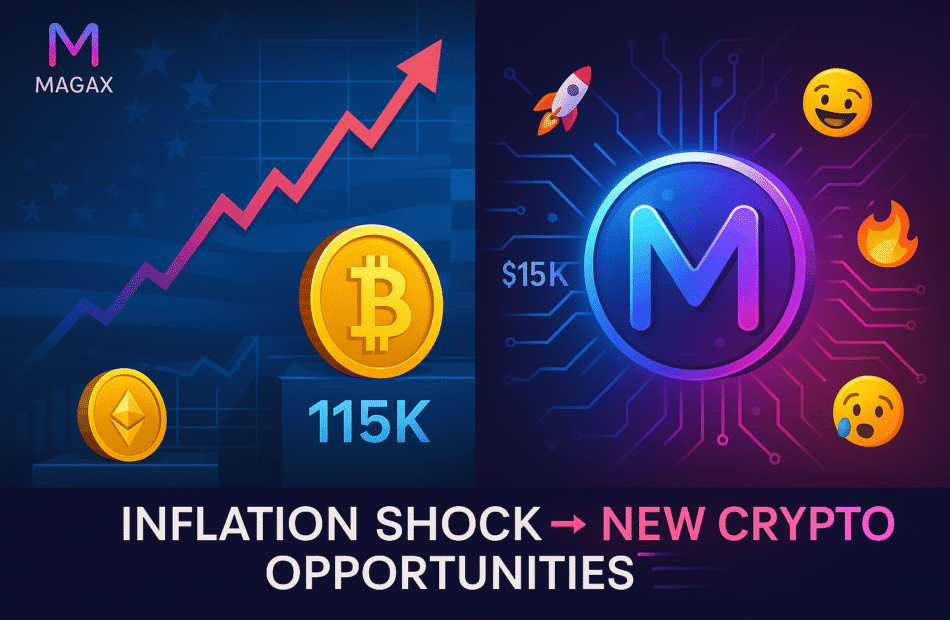
MAGAX Presale Gains Traction Amid Inflation Fears
U.S. inflation surprised markets this week, rising more than expected and sending shockwaves through both traditional finance and crypto. The Consumer Price Index (CPI) for August showed a 0.4% increase from the previous month and a 2.9% jump year-over-year. This unexpected rise in inflation shook stock markets, pushed yields higher, and once again pushed investors toward crypto as a hedge.
Bitcoin quickly responded, climbing closer to $120,000, while Ethereum held steady, helped by strong ETF inflows. But the real buzz is happening elsewhere—specifically in the world of presale utility tokens. These are early-stage cryptocurrencies that offer real use cases from day one, and right now, one of them is quietly gaining traction: Moonshot MAGAX.
Unlike typical meme coins or altcoins that often launch without any real purpose, MAGAX offers actual utility. It combines the viral appeal of meme tokens with smart features powered by AI. This gives it a unique edge in the current market, especially for U.S. retail investors who want more than just speculative gains—they want something they can actually use.
MAGAX is built with a Meme-to-Earn model that rewards users for community participation. It also includes AI tools to make engagement fair and smarter. Plus, it has a deflationary setup with regular token burns and a capped supply. This means fewer tokens over time, which could increase value if demand grows.
Presale tokens like MAGAX often do well when the broader market is uncertain. As stocks struggle and inflation lingers, traders are looking for new opportunities. MAGAX offers just that—an early-stage project with real features and growing interest.
Interest in MAGAX is building fast. Early presale rounds are selling out quicker than expected, and large crypto wallets—known as whales—have started buying in. The mix of real utility and meme-driven hype is attracting both serious investors and everyday traders.
What’s also fueling excitement is the timing. Gemini’s recent IPO has brought more institutional eyes back to crypto, creating a ripple effect across the industry. When big names make headlines, savvy investors start searching for the next breakout star—and MAGAX is starting to look like one.
Looking ahead, the key question is whether MAGAX can keep up its momentum. Will it secure listings on major exchanges after the presale ends? Can it turn early hype into long-term adoption? Its success will depend on how well it delivers on its promises.
If all goes well, 2025 could be a breakout year for MAGAX. But like all presales, it carries risk—strong execution is essential. Still, for investors paying attention now, this could be a chance to get in early on a token with real potential.
In crypto, timing is everything. While Bitcoin and Ethereum dominate the news, the biggest gains often come from spotting strong projects before they go mainstream. MAGAX may be one of those rare early opportunities: a presale token with actual utility, built-in scarcity, and community-driven growth potential.
For those watching closely, today’s curiosity could become tomorrow’s FOMO.

Bitcoin Nears Breakout as Firms Invest, HYPER Presale Soars
**Bitcoin Price Rises as More Companies Jump In**
Bitcoin (BTC) is currently trading around $115,569, with a total market value (market cap) of $2.3 trillion. There are nearly 20 million bitcoins in circulation. The price is up by nearly 1% in the last 24 hours, driven by new interest from companies adding Bitcoin to their balance sheets.
One major headline came from fashion retailer Mogu, which is listed on the Nasdaq. Its stock surged as much as 76% after the company announced it invested $20 million into Bitcoin, Ethereum, and Solana. Mogu said the move is part of a plan to diversify its treasury and prepare for next-generation AI services. After hitting $37 in 2021, Mogu’s stock had fallen to just $4.40, but this crypto investment brought new attention.
This move puts Mogu in the same category as other companies like MicroStrategy, which has become famous for holding a huge amount of Bitcoin — 638,460 BTC worth over $73 billion. These corporate investments show a growing trend where businesses see Bitcoin and other digital assets as both a hedge against inflation and a way to attract investor interest.
**Bitcoin Technical Outlook: What the Charts Say**
On the technical side, Bitcoin is currently forming an “ascending triangle” pattern. This means prices are making higher lows while facing resistance at a key level — right now that resistance is around $116,342. This kind of pattern often leads to a breakout.
Two important moving averages — the 50-day EMA (at $113,370) and 200-day EMA (at $112,937) — are trending upward, giving support to Bitcoin’s price. Momentum indicators are also positive. The Relative Strength Index (RSI) is at 64, which shows buyers are active but it’s not yet in the “overbought” zone.
If Bitcoin can break above $116,342, it could quickly move toward $117,456 and even $118,617 — both previous high points. However, if it falls below $114,819, there’s a chance it could pull back to around $113,383. Still, the overall trend looks bullish due to the pattern of higher lows.
Traders looking for a good risk/reward setup might consider entering a long position if Bitcoin breaks above $116,350, with a stop-loss at $113,000. Short-term targets include $118,600, and if momentum continues, we could see a push toward $130,000.
For long-term investors, this current period of price consolidation might be the last stop before a bigger move upward. Growing interest from companies and institutional investors is adding fuel to Bitcoin’s rise and reinforcing its image as “digital gold.”
**New Layer 2 Project: Bitcoin Hyper ($HYPER)**
Meanwhile, a new project called Bitcoin Hyper (HYPER) is aiming to expand what Bitcoin can do. It’s being built as the first Bitcoin-native Layer 2 solution using the Solana Virtual Machine (SVM). The goal is to bring fast and low-cost smart contracts and decentralized apps (dApps) to the Bitcoin ecosystem.
By combining Bitcoin’s strong security with Solana’s high-speed performance, HYPER opens new possibilities like creating meme coins, developing scalable dApps, and easy BTC bridging between networks.
The project has been audited by Consult to ensure trust and security for investors. Interest is growing fast — the presale has already raised over $15.3 million. Right now, HYPER tokens are priced at just $0.012905 during this phase of the presale.
Anyone interested can buy HYPER tokens directly from the official Bitcoin Hyper website using either cryptocurrency or a bank card.
**Key Takeaways**
– Bitcoin trades around $115K with strong support from corporate buyers
– Mogu’s crypto investment sparks a 76% stock surge
– Technical signals point to a potential breakout above $116K
– Traders eye targets near $118K and beyond
– New project Bitcoin Hyper brings fast smart contracts to BTC using Solana tech
– HYPER token presale crosses $15M with growing investor interest
With growing adoption from companies and innovation in Layer 2 solutions like HYPER, Bitcoin’s path forward continues to gain momentum — both as an asset and a platform for development.

MAGAX Emerges as Top Crypto Contender in 2025
The crypto market in Q4 2025 feels more like a battleground than a place to park your money. Big names like Bitcoin, Ethereum, and Solana are still leading the charge, but a new player is turning heads — not with history or hype, but with culture, AI, and strong community support.
This isn’t just about staying alive in the market. It’s about who can lead it. And while the top coins are still holding their ground, one fresh project is quickly becoming the crowd favorite.
Let’s talk Bitcoin. It’s the most recognized name in crypto, trading near $113,950 with a massive $2.27 trillion market cap. For over 10 years, Bitcoin has been the go-to coin for investors, especially with ETFs making it more accessible to institutions. If you bought $1,000 worth in 2012, you’d be a millionaire today.
But here’s the catch: the days of getting rich quick with Bitcoin are over. It’s now seen as a safe, stable option — not a big growth opportunity. That’s why many investors are looking for something newer, cheaper, and with more upside potential.
Solana is fast — that’s its main selling point. It processes transactions quickly and is popular among developers building apps. But recently, it’s faced network issues and outages that have hurt its image. And in today’s market, speed alone isn’t enough to stand out.
Ethereum is the backbone of decentralized finance (DeFi) and smart contracts, powering platforms that manage over $50 billion. Its recent upgrade made it much more energy efficient — cutting power use by 99.9%. From 2023 to 2024, Ethereum doubled in value, making it a solid long-term investment.
Still, Ethereum struggles with high gas fees and slow transaction speeds. For smaller investors, these problems make it hard to get involved without spending a lot. That’s where the new contender changes everything — offering low entry costs and rewarding user creativity.
Enter MAGAX — a rising crypto project that’s still in its early stages and full of potential. Unlike the major coins where most of the gains have already been made, MAGAX is just getting started. And history shows that early movers often see the biggest returns.
But MAGAX isn’t just about money. It’s solving a real problem in today’s digital world: creators who make memes, videos, and viral content get nothing in return. MAGAX flips that model by paying people for their cultural contributions. It turns everyday participation into real rewards.
Bitcoin gives us trust and legacy. Solana brings speed. Ethereum offers structure. But when it comes to raw return on investment (ROI) potential in this cycle, MAGAX is stealing the spotlight.
The project is currently in Stage 2 of its presale at just $0.000293 per token. Over 80,000 people have already joined in. Each stage sells out fast — and the price increases with every round.
If you’re looking for the next big thing in crypto, this might be it. Don’t sit on the sidelines while others ride the wave of the Meme-to-Earn movement. Now’s your chance to get in early before prices surge again.
DeepSeek AI Predicts Big Gains for XRP, Pi Coin & Solana
**Disclaimer: Crypto is a high-risk investment. This article is for informational purposes only and should not be taken as financial advice. You could lose all of your money.**
—
**China’s DeepSeek AI Bullish on XRP, Pi Coin, and Solana as Crypto Market Heats Up**
As the holiday season approaches, China’s top AI project DeepSeek—often called the country’s version of ChatGPT—is predicting a strong rally for XRP, Pi Coin, and Solana. With crypto markets gaining momentum and Bitcoin recently hitting a record high of $124,128 before pulling back slightly, many believe altcoins could be gearing up for another big run.
The total crypto market cap has climbed 1.4% in the past 24 hours, now sitting at $4.11 trillion. Regulatory clarity is also improving: President Trump just signed the GENIUS Act, which is the first U.S. law to regulate stablecoins with full-reserve backing. Meanwhile, the SEC launched Project Crypto to help blockchain companies meet compliance requirements more easily.
This mix of positive price action and clearer rules is giving investors hope for a new altcoin season—similar to what happened in 2021. Here’s what DeepSeek AI expects from XRP, Pi Coin, and Solana.
—
**XRP Could Triple in Price—DeepSeek AI Sees $10 Target**
According to DeepSeek AI, XRP (Ripple) could reach up to $9 by late 2025—about 3x its current price of around $3.04. The coin recently hit a new all-time high of $3.65 in July before pulling back by 16.5%.
Several big factors are helping XRP stay in the spotlight. Ripple has strong global partnerships and recently gained support from the UN Capital Development Fund for cross-border payments. Also, earlier this year, the SEC ended its long-running lawsuit against Ripple, confirming that regular XRP sales to individuals are not considered securities.
DeepSeek AI’s base forecast puts XRP between $5 and $10 if U.S. policymakers continue pushing pro-crypto regulation. If Ripple gets an ETF approved and gains more traction with banks and institutions, hitting the higher end of that range becomes more likely.
On the charts, XRP looks strong too. The Relative Strength Index (RSI) is rising from 57, and three bullish flag patterns have formed this year—two in the summer alone—indicating a possible breakout soon.
XRP has already gained 465% over the past year, beating Bitcoin’s 98%, Ethereum’s 93%, and Solana’s 77.5% returns.
—
**Pi Coin Could See 14x Growth by Year-End**
Pi Coin ($PI) is catching attention thanks to its mobile-friendly mining system that lets users earn coins just by tapping a button once a day.
Currently priced at about $0.35, DeepSeek AI believes it could rise to $5 by the end of this year—representing a potential 14x gain in under four months.
Since launching in February 2025, Pi Coin has seen some big price swings—including a 171% jump in May. The RSI currently sits at a neutral 48, suggesting that PI is fairly priced and has room to grow.
If the overall crypto market keeps recovering and more users join the Pi Network, analysts say it’s realistic for PI to retest its earlier high of $2.99 and possibly go even higher.
Even if it doesn’t hit the extreme $5 target, reaching $3 by year-end is still seen as likely—especially if U.S. crypto policy continues to improve.
—
**Solana Aiming for $1,000+—Strong Growth and ETF Buzz Fueling Hype**
Solana ($SOL) remains one of the top smart contract platforms in crypto. With a current market cap of $130 billion and $13 billion locked across its network, it’s seen as Ethereum’s biggest rival.
Investors are getting excited about rumors that a Solana ETF could be coming soon in the U.S. There are also hints that President Trump may include SOL in a proposed national Bitcoin reserve—but only from law enforcement seizures, meaning it wouldn’t be purchased directly.
SOL has shown strong price action lately. After dipping to $100 in April, it bounced back to around $240 today. However, it’s now facing some resistance and may trade sideways in the short term.
Earlier this year, Solana broke out of bearish trends. Based on DeepSeek AI’s forecast, SOL could reach $1,000 or even $1,500 by late 2026 if positive momentum continues and crypto regulation becomes more supportive.
Its previous all-time high was $293, so this would be a major leap—but one that’s possible with continued adoption and favorable policies.
—
**Maxi Doge ($MAXI): High-Risk Meme Coin with Big Hype**
For those looking for something riskier but with potential upside, Maxi Doge ($MAXI) is getting a lot of buzz as a new meme coin inspired by Dogecoin—but with an even wilder twist.
Built on Ethereum, MAXI focuses on community growth through Telegram groups, contests, and collaborations. The presale has already raised over $2 million in just a few weeks.
MAXI has a total supply of 150 billion tokens. Out of that, 25% is set aside for marketing and partnerships. Early holders can stake their tokens for up to 155% APY returns—but those rewards will drop as more users stake their coins.
Currently priced at $0.000257, MAXI’s presale price increases slightly with each funding round. You can buy it through the official Maxi Doge website using popular wallets like MetaMask or Best Wallet.
For updates, follow Maxi Doge on their official X (Twitter) and Telegram pages.
—
**Key Takeaways:**
– **XRP** could hit $10 by late 2025 thanks to institutional interest and regulatory clarity.
– **Pi Coin** might rise as high as $5 this year due to user growth and unique tap-to-mine feature.
– **Solana** is targeting up to $1,500 by late 2026 with ETF rumors and strong fundamentals.
– **Maxi Doge** offers high-risk/high-reward potential with strong early community support.
Crypto remains volatile, but with improving regulations and growing adoption, many altcoins are showing strong signs of life heading into the next bull cycle.