

Top Crypto Coins to Watch in 2025 for Smart Investors
**Top Crypto Coins to Watch in 2025: A Simple Guide for Smart Investors**
The crypto market in 2025 is moving into a new phase. After years of hype, wild price swings, and confusing regulations, things are starting to settle. Traders are now focusing more on long-term value instead of quick gains. If you’re wondering what the best coins to invest in are for 2025, here’s what you need to know.
### Bitcoin (BTC) – The Safe Foundation
Bitcoin is still the heart of the crypto world. It’s the most trusted and widely used digital currency. In 2024, Bitcoin went through a halving event, which reduced the amount of new coins being created. At the same time, more big institutions started buying Bitcoin through ETFs. This combo could make Bitcoin even more valuable in 2025.
**Investor tip:** Use Bitcoin as your base investment. It’s stable, easy to trade, and less risky than most other coins.
### Ethereum (ETH) – The Power Behind Decentralized Apps
Ethereum continues to lead when it comes to decentralized applications (dApps) and tokenized assets. Recent upgrades like EIP-4844 (also called Proto-Danksharding) have made Ethereum faster and cheaper to use. More developers and users are joining the network.
**Investor tip:** Ethereum is still a solid long-term investment if you believe in the future of smart contracts and dApps.
### Solana (SOL) – The Fast-Growing Challenger
Solana is making a strong comeback in 2025. Known for its super-fast transactions and low fees, Solana is attracting attention from developers building NFTs, Web3 apps, and DeFi platforms. It’s riskier than Bitcoin or Ethereum but has high upside potential if adoption continues.
**Investor tip:** Use Solana as your growth coin. It’s not as stable, but it could bring bigger rewards.
### Chainlink (LINK) – The Data Provider for Crypto
Chainlink connects smart contracts with real-world data like prices, weather, and more. As tokenized real-world assets become more common, the need for reliable data sources like Chainlink grows too.
**Investor tip:** Add Chainlink to your portfolio for steady utility and diversification. It’s a strong infrastructure coin that works across many crypto sectors.
### Ripple (XRP) – Built for Payments
Ripple focuses on fast, low-cost international payments. Its XRP Ledger allows banks and financial companies to move money quickly and cheaply across borders. This makes it a strong option for practical use.
**Investor tip:** XRP is a medium-risk pick with real-world use cases and lower volatility than many altcoins.
### IPO Genie (IPO) – The AI + Blockchain Token to Watch
IPO Genie is one of the most interesting new projects in 2025. It blends artificial intelligence with blockchain technology to offer smart investment insights, early access to private deals, and rewards for long-term holders.
**Investor tip:** If you’re into AI and data-driven investing, keep an eye on IPO Genie’s presale. It could be one of the next big things in crypto.
IPO Genie isn’t just another token — it’s built around real utility. Users get access to exclusive investment opportunities, AI-powered analytics, and staking rewards. It’s ideal for investors who want more than just speculation.
—
### Building a Smart Crypto Portfolio in 2025
The best crypto portfolio in 2025 balances safety with growth. Here’s a sample structure:
– **Bitcoin (BTC)** – Core stability
– **Ethereum (ETH)** – Long-term infrastructure
– **Solana (SOL)** – High-growth potential
– **Chainlink (LINK)** – Useful data provider
– **Ripple (XRP)** – Payments utility
– **IPO Genie (IPO)** – AI-powered innovation
This mix gives you exposure to established leaders and emerging trends like AI, Web3, and DeFi.
—
### What Else to Watch in 2025?
Aside from the major names, keep an eye on smaller tokens in AI, gaming, and DeFi spaces. These areas are growing fast and could produce breakout stars. Just remember: higher reward usually comes with higher risk.
—
### Stay Cautious: Challenges in the Crypto Market
Even though 2025 looks promising, it’s not without risk. Regulatory changes in the U.S., Europe, and Asia could impact how some tokens are traded or taxed. Exchanges can still face security issues or liquidity problems. And hype-driven meme coins are still around, pulling attention away from more serious projects.
To succeed, stay focused on facts, not hype. Always base your strategy on real data and do your research before investing.
—
### Final Thoughts
2025 is shaping up to be a big year for smart crypto investors. While Bitcoin and Ethereum remain must-haves, newer tokens like IPO Genie are showing how AI and blockchain can work together to create real value.
**Ready to explore the future of crypto?**
Check out IPO Genie’s presale and analytics tools today to see how AI can power your portfolio.
**Reminder:** Always do your own research before investing. Look into each project’s whitepaper, team background, tokenomics, and community support. Avoid coins with no clear use case or unrealistic promises. Regulation and security should be part of every investment decision you make this year.

Crypto Markets Wobble Amid Fed Uncertainty, Shutdown Fears
The U.S. government is facing a potential shutdown, and that’s making investors nervous. Along with concerns about how artificial intelligence is being valued and signs that the job market is slowing down, all eyes are now on what the Federal Reserve will say this week. Several important economic reports are also expected soon, but they might get delayed due to the shutdown.
These developments are creating uncertainty in the markets, especially in the cryptocurrency space. Bitcoin and Ethereum are feeling the pressure, showing more price swings than usual. Investors are becoming more cautious, pulling back from risky assets like crypto while they wait for more clarity.
What the Federal Reserve says about interest rates and the economy could have a big impact. If they hint at raising rates or tightening policy, it could make things even shakier for digital assets. On the flip side, any sign of support from the Fed could calm things down.
According to research from Coincu, if the government shutdown continues, it could cause problems in both funding and regulation across the financial and crypto sectors. History shows that past shutdowns, like the one in 2018-2019, have caused short-term volatility in Bitcoin and Ethereum. On-chain data is already showing possible outflows from decentralized finance (DeFi) platforms, a signal that investors may be moving their money out of riskier crypto assets.
Bitcoin is currently priced at $101,884.47 with a market cap of $2.03 trillion. Over the last 24 hours, it’s up by 2.46%, but it’s still down by 17.48% over the past month. The daily trading volume stands at $77.78 billion, and there are 19,945,978 BTC currently in circulation.
For crypto investors, this is a time to stay alert. With economic uncertainty rising, unpredictable price swings are likely to continue. Watching what the Federal Reserve says—and how long the shutdown lasts—will be key to understanding where markets are headed next.
Blazpay Presale Booms: 78% Sold Before Price Hike
**Blazpay Presale Nearing Sell-Out as Investors Race to Get In Before Price Surge**
The crypto market remains relatively stable, but there’s a noticeable slowdown in excitement. Bitcoin (BTC) is trading around $103,000, and Ethereum (ETH) sits near $3,370. Both are holding steady after months of gradual gains, but investors are now looking for fresh opportunities.
One project that’s grabbing attention is Blazpay – a new AI-powered crypto that’s quickly becoming one of the hottest presale coins of 2025. While Bitcoin and Ethereum are consolidating, Blazpay’s Phase 3 presale is surging. It has already raised over $1.15 million and is 78.2% sold out, with more than 157 million tokens gone out of the 201.89 million available at this stage.
Time is running out – only a few days remain before Phase 4 begins and the price jumps from $0.009375 to $0.01175 per BLAZ. Early investors are hurrying to lock in tokens now before the price increases.
**What Makes Blazpay Stand Out?**
Blazpay isn’t just another crypto token. It combines artificial intelligence (AI), financial technology (fintech), and multi-chain compatibility in one complete ecosystem. It’s designed for both everyday users and professional traders.
At the heart of Blazpay is its SDK (Software Development Kit), which lets developers plug Blazpay’s AI tools into other apps. This means smarter payment systems, automated transactions, and seamless cross-chain functionality on networks like Ethereum, Binance Smart Chain (BNB), Polygon, and Solana.
Blazpay also features AI-powered perpetual trading. This system uses advanced algorithms to help users make better trading decisions, like spotting the best times to enter or exit trades based on market trends and volatility.
All of this makes Blazpay more than just a coin—it’s a working product with real-world uses, setting it apart from most other new crypto projects.
**Bitcoin: Reliable but Slowing Down**
Bitcoin remains the leader in crypto and a strong store of value. At around $103,000 per coin, it continues to be a favorite among big investors. But as it matures, its growth potential is slowing. Experts believe Bitcoin could reach between $115,000 and $125,000 by the end of 2025—solid gains but not as explosive as newer projects.
Bitcoin is dependable, but it doesn’t offer the kind of innovation or excitement that newer AI-driven coins like Blazpay provide.
**Ethereum: Powerful but Facing Challenges**
Ethereum still leads when it comes to smart contracts and decentralized applications (dApps). It plays a huge role in DeFi and NFTs, trading around $3,370 per ETH. But high gas fees and scaling problems continue to hold it back.
Ethereum’s future looks good, with price predictions between $4,200 and $4,800 by mid-2026. However, without major upgrades or new features, its returns may remain modest compared to more agile projects like Blazpay.
Unlike Ethereum, Blazpay offers AI automation, developer tools (SDK), and advanced trading options—all in one place.
**Why a $3,000 Investment in Blazpay Could Pay Off Big**
If you invest $3,000 in Blazpay during Phase 3 at $0.009375 per token, you’ll get about 320,000 BLAZ tokens. If the coin reaches its projected listing price of $0.08 to $0.10, that investment could grow to between $25,000 and $32,000—a return of 9x to 10x.
Compared to Bitcoin or Ethereum, this kind of early-stage growth potential is much harder to find.
**Blazpay’s Secret to Presale Success**
Blazpay has hit over $1.15 million in presale funds in just a few weeks thanks to its real utility and rewards system. Its multi-chain support and AI-driven ecosystem are attracting both developers and traders.
One unique feature is Blazpay’s referral program that gives real-time USDT rewards—not just extra tokens—which adds a powerful incentive for users to share the project with others.
This combination of technology, usability, and reward mechanics has made Blazpay one of the most talked-about AI crypto projects heading into 2025.
**Blazpay vs Bitcoin vs Ethereum: Future Price Predictions**
– **Blazpay (BLAZ):** Short-term price target is $0.05 to $0.08 shortly after listing. Longer-term projections for 2025 range between $0.12 and $0.18. By 2030, some analysts see it hitting $0.80 to $1.00.
– **Bitcoin (BTC):** Expected to trade between $115K–$125K by late 2025.
– **Ethereum (ETH):** Could rise to around $4,200–$4,800 by mid-2026.
Blazpay offers higher upside potential due to its low entry point and expanding ecosystem.
**How to Buy Blazpay (Step-by-Step)**
1. Visit www.blazpay.com
2. Click on “Presale”
3. Connect your wallet (MetaMask, WalletConnect, Coinbase Wallet)
4. Choose your payment method (USDT, ETH, BNB, BTC, or SOL)
5. Enter your investment amount and confirm your purchase
Tokens are delivered instantly to your connected wallet.
**The Bottom Line: Why Blazpay Is the Future of Crypto**
Bitcoin and Ethereum remain solid investments—but they’ve already seen most of their big growth years. For those seeking the next major opportunity in crypto, Blazpay offers something different: AI-powered tools, real developer utility via SDKs, cross-chain compatibility, and perpetual trading features—all in one platform.
With Phase 3 almost sold out and the price set to rise soon, time is limited for early buyers to get in at the lowest rate possible.
Blazpay isn’t just another crypto—it’s a fully functional AI-fintech platform that could reshape how people interact with blockchain technology.
**Join the Blazpay Community**
– Website: www.blazpay.com
– Twitter: @blazpaylabs
– Telegram: t.me/blazpay
**FAQs About Blazpay**
**Q1: What makes Blazpay special?**
It combines real AI tools with finance and trading features through an SDK—offering real utility instead of just hype.
**Q2: How much has Blazpay raised so far?**
Over $1.15 million with more than 78% of Phase 3 tokens sold.
**Q3: How is it different from Bitcoin or Ethereum?**
Blazpay offers automated trading tools and AI integration—features BTC and ETH don’t have right now.
**Q4: What’s the expected price after listing?**
Analysts expect it to open between $0.08–$0.10—up to 10x returns for early investors.
**Q5: How do I join the presale?**
Go to blazpay.com, connect your wallet, pick your payment token, invest—and you’re done!
AI and Crypto Trades Cool as Market Sentiment Shifts
The stock market didn’t crash this week, but signs of weakness are starting to show in high-risk areas. After months of wild speculation by retail investors and huge bets on artificial intelligence, some of the flashiest parts of the market are beginning to cool off.
Big-name tech stocks took a hit, marking their worst performance since April. Companies like Palantir and Oracle dropped sharply, dragging down leveraged ETFs and popular meme-stock trades. These losses hint that the recent hype around AI might be wearing thin.
One of the clearest warning signs is coming from the crypto world. Bitcoin, which had surged earlier this year, is now sliding. It’s been dropping toward $100,000 again and again, as fewer buyers are stepping in. Many investors who used leverage have already been wiped out, and confidence in the market hasn’t recovered.
Wall Street experts have been warning that AI stocks were getting too expensive compared to their real-world profits. Now that caution is becoming reality. Risky trades tied to AI and crypto are no longer offering guaranteed rewards. Money is still flowing in, but not like before.
Palantir is a good example of how sentiment has changed. Even though it reported strong earnings, its stock fell 8% the next day. This shows that even crowd favorites are vulnerable when expectations are sky-high. According to behavioral economics professor Peter Atwater, Palantir sits right alongside AI and crypto in investors’ minds—these trades all rely on intense public confidence.
We’re not seeing a total collapse, but there’s a clear shift. Some high-risk trades that were once booming are now falling apart. For example, an ETF tied to Meta dropped 8.5% this week, while another focused on Palantir lost 22%. A tech innovation ETF fell over 20%, and trades involving Super Micro Computer also stumbled.
The major tech players—known as the “Magnificent Seven”—fell about 3% as investors started questioning their big spending on AI projects. A comment from OpenAI’s CFO about possible government support for AI funding made some people even more nervous.
Atwater says we’re seeing a turn in mood. As excitement fades, skepticism is growing. If this continues, markets may not bounce back as easily as they did before.
Meme stocks, unprofitable tech firms, and recent IPOs all pulled back over the past week. An ETF tracking new market entries fell 5%, the worst drop since September. Another ETF filled with unprofitable tech names fell 7%, its biggest slide since August.
Crypto-related ETFs have also seen massive outflows. In just one week, over $700 million was pulled out—$600 million from BlackRock’s Bitcoin fund and $370 million from its Ether product. Tokens like Solana and Dogecoin have dropped double digits since their recent launches. Even the new MEME ETF is down over 20% since its debut just a month ago.
Investors are getting nervous. Stephen Kolano from Integrated Partners says people are cashing out of the trades that have run up the most—mostly those tied to AI and crypto.
This shift could have broader effects. Retail investors helped push markets higher earlier this year despite other economic pressures. But now that riskier trades are losing steam and cash is being pulled out, liquidity may be drying up at the edges.
Still, this isn’t a full-blown crash. The S&P 500 is only down about 2% from recent highs. But for many investors who believed everything would keep going up, this week feels different. Timing matters again, and leverage—borrowing to invest—can hurt just as much as it helps.
Bitcoin’s recent 15% drop is raising eyebrows not just for how much it fell, but when it happened. Some analysts now see Bitcoin as an early warning sign for high-risk tech stocks and retail investor activity. Citi reports that large holders of Bitcoin—so-called whales—are starting to sell. These investors usually hold through tough times, so their exit is especially worrying.
Bitcoin trades around the clock, making it a powerful signal for market sentiment. Eric Balchunas from Bloomberg Intelligence says it acts like a nonstop price-check system because traders are always online and reacting fast.
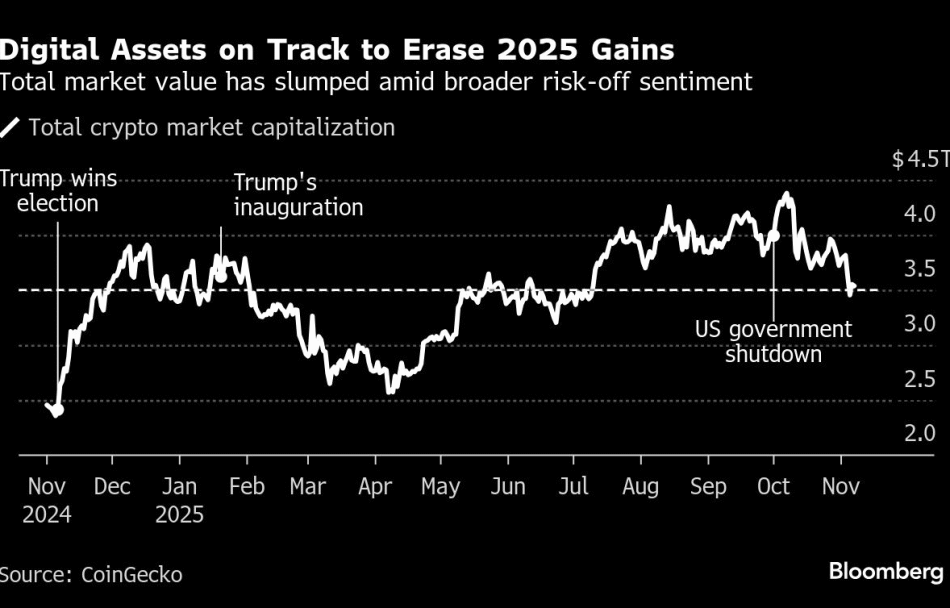
The decline is even more surprising given how much political support crypto has gained recently. Earlier this year, Bitcoin got a boost from Donald Trump’s push to make the U.S. a leader in crypto innovation. But after peaking at around $4.4 trillion in October, the total value of all digital tokens has dropped nearly 20%, erasing most of this year’s gains.
For those who thought clearer regulations would spark a new crypto boom, this rapid reversal has been tough to watch. Ilan Solot from Marex says there just isn’t enough new money coming in to replace those exiting the market. Many investors are burned out—financially and emotionally—and can’t handle another rough crypto cycle.
To turn things around, big holders need to stop selling, and ETF flows need to stabilize. Until then, riskier parts of the market may continue to struggle.

Crypto Presale Mistakes to Avoid in 2025
**Crypto Presale Guide 2025: Avoid These Common Mistakes**
Crypto presales can feel like a golden ticket — a chance to get in early on a new token before it becomes big. The dream? Turn a small investment into massive profits. But for every success story, there are countless people who lose money, sleep, and trust in the process.
Presales aren’t scams by default. The real issue is that many people jump in without knowing what they’re doing. The hype, fear of missing out (FOMO), and flashy promises can lead to poor decisions. Just one wrong move — like investing in a bad token — can turn an opportunity into a disaster.
The good news? Succeeding in crypto presales isn’t about luck. It’s about knowledge, planning, and self-control. Here’s a simplified breakdown of the five biggest mistakes investors make in crypto presales — and how to avoid them.
—
**Mistake #1: Falling for Hype Instead of Doing Research**
Many people don’t fall for scams — they fall for stories. Promises of AI-powered trading or “revolutionary” platforms often turn out to be copy-pasted projects with no substance.
Social media makes this worse. A fancy website, a countdown clock, and influencers hyping up a presale can make it look legit. But when you dig deeper, there’s no team, no working product, and no real plan.
**How to Avoid It:**
– Read the project’s whitepaper carefully.
– Make sure the team is real and experienced — anonymous founders are a red flag.
– Look for independent security audits.
– Ask basic questions: Does the project solve a real problem? Are the tokenomics realistic?
If you can’t answer yes to both, move on. Smart investors dig for facts, not just hype.
—
**Mistake #2: Letting FOMO and Greed Control Your Decisions**
Imagine a Telegram group blowing up with “last chance” alerts. A presale says it’s almost sold out. You panic-buy — only to watch the price crash by 70% days later.
FOMO pushes you to act fast without thinking. Greed tells you to hold longer hoping for more gains. Both can wreck your portfolio.
**How to Avoid It:**
– Make a clear plan before investing — set your entry and exit points when you’re calm.
– Only invest money you can afford to lose.
– Don’t check prices constantly — it increases anxiety and leads to bad decisions.
The best crypto investors follow a strategy, not emotions.
—
**Mistake #3: Putting All Your Money Into One Presale**
Many new investors throw everything into one token, thinking it’s their ticket to huge returns. But even good projects can fail.
Experienced investors spread their bets across different projects. They know not every token will win, even among the top crypto presales of 2025.
**How to Avoid It:**
– Diversify across sectors like DeFi, gaming, AI, and tokenized assets.
– Keep some funds in safer options like Bitcoin or Ethereum.
– Limit each presale investment to 5–10% of your total crypto capital.
Diversification doesn’t kill profits — it protects your capital.
—
**Mistake #4: Expecting Fast Profits Instead of Long-Term Growth**
Many people expect a quick pump after the token launch. But real growth takes time. Projects need months or even years to build products, grow communities, and prove their value.
Impatient investors often sell too early and miss out on future gains.
**How to Avoid It:**
– Think long-term. Hold solid projects for 2–5 years if fundamentals stay strong.
– Follow project updates instead of watching price charts.
– Be realistic — good projects have delays and changes along the way.
Patience is your biggest edge in crypto presales.
—
**Mistake #5: Ignoring Security and Losing Everything**
The horror story is always the same: “I checked my wallet, and everything was gone.” One wrong link, one phishing site, or one hacked exchange can wipe out your funds.
Too many people focus on what to buy but forget to protect what they already have.
**How to Avoid It:**
– Use secure wallets — hardware wallets are best.
– Store your seed phrase offline in a safe place.
– Track all your transactions for security and tax purposes.
– Set stop-losses if you’re actively trading to limit potential losses.
Your investment isn’t real until it’s protected.
—
**Bonus Tip: Don’t Trust the Hype – Verify Everything**
Presale marketing is often full of hype. Flashy videos, fake partnerships, and paid influencers can make anything look legit.
Before you trust any claims:
– Check announcements on official project channels.
– If there’s a partnership with a well-known exchange or platform, confirm it directly.
– Look for real audits and transparency — not just good-looking ads.
Real investors look for proof, not promises.
—
**Final Thoughts: Crypto Presales Need Strategy, Not Hope**
Presales are exciting — they offer big potential rewards. But they also come with high risks if you don’t have a plan.
The most successful investors in 2025 won’t be the lucky ones. They’ll be the disciplined ones who do their homework, manage their risk, and think long-term.
So before you join the next hot presale, ask yourself:
– Have I done my research?
– Is my money safe?
– Do I have a clear plan?
If you answered yes, you’re ahead of most people already. In crypto, avoiding big mistakes is what puts you in position for big wins later.
**Disclaimer:** This article is for educational purposes only and does not offer financial advice. Always do your own research before making any investment decisions.